Turning Waste Into Memory
In the work of Serge Attukwei Clottey, Ghana’s artistic landscape finds one of its most vital and globally resonant voices. His yellow plastic tapestries, stitched from discarded gallon containers, speak not only to environmental urgency but also to the deep cultural and material entanglements that shape modern Ghana.
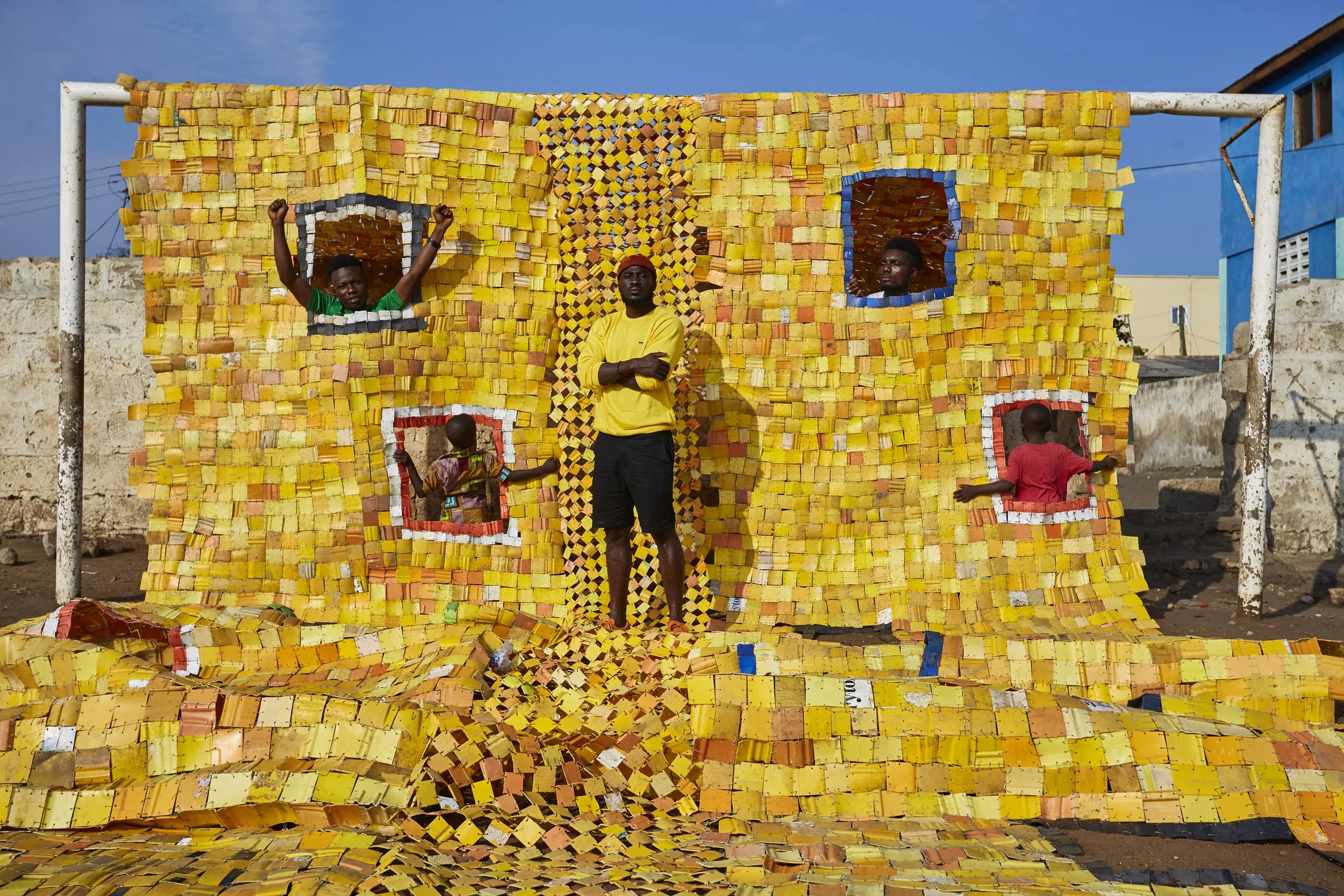
Serge Attukwei Clottey
Living between Accra and Los Angeles, Serge Attukwei Clottey moves effortlessly between two worlds, yet his art remains rooted in Ghana’s streets and shorelines. The artist’s practice has become synonymous with Afrogallonism, his long-term project that transforms yellow plastic jerrycans, once used to transport cooking oil from the West into Africa, into vast, shimmering installations. Cut, melted and sewn together, the containers become something both delicate and monumental: a metaphor for waste and renewal, dependence and resilience, migration and return.
“Afrogallonism,” as Clottey calls it, is more than a commentary on recycling. It is an act of reclamation. The yellow containers, now ubiquitous across Ghana’s urban landscapes, carry histories of trade, consumption and environmental neglect. Through Clottey’s hands, they are reimagined as symbols of a new artistic economy, one that reverses the flow of value and meaning from the West to Africa.
Gallery 1957’s notes that “Clottey’s work stands at the crossroads of art, politics and daily life. He creates a language out of what has been discarded, and in doing so, he reminds us that Ghana’s most ordinary materials carry extraordinary histories.”
This dialogue between the local and the global is a thread that runs through Ghana’s contemporary art scene, from the symbolic portraiture of Otis Kwame Kye Quaicoe to the material investigations of Denyse Gawu-Mensah. Together, these artists embody a confident generation redefining what African art can be: expansive, self-aware and deeply connected to place.

Clottey’s other works, such as My Mother’s Wardrobe, delve into themes of kinship and gender, transforming acts of mourning into performance and ritual. His recent Beyond Skin series, inspired by mid-century black-and-white photography, questions who gets to frame African identity, and how self-representation can evolve in a
postcolonial world.
Whether through fabric, plastic or performance, Clottey’s work blurs the line between the personal and the political. In his art, Ghana’s everyday life, its materials, markets and memories, becomes a map of global exchange and human resilience. n