Reframing Ghana: Contemporary artistic voices
As Gallery 1957 continues to define Ghana’s place on the global contemporary art stage, its latest exhibition brings together strikingly distinct voices: painter Otis Kwame Kye Quaicoe and multidisciplinary artist Denyse Gawu-Mensah. Exhibited alongside Serge Attukwei Clottey (see page 52), their work deepens the conversation around identity, heritage and the evolving power of Ghanaian creativity.
Denyse Gawu-Mensah
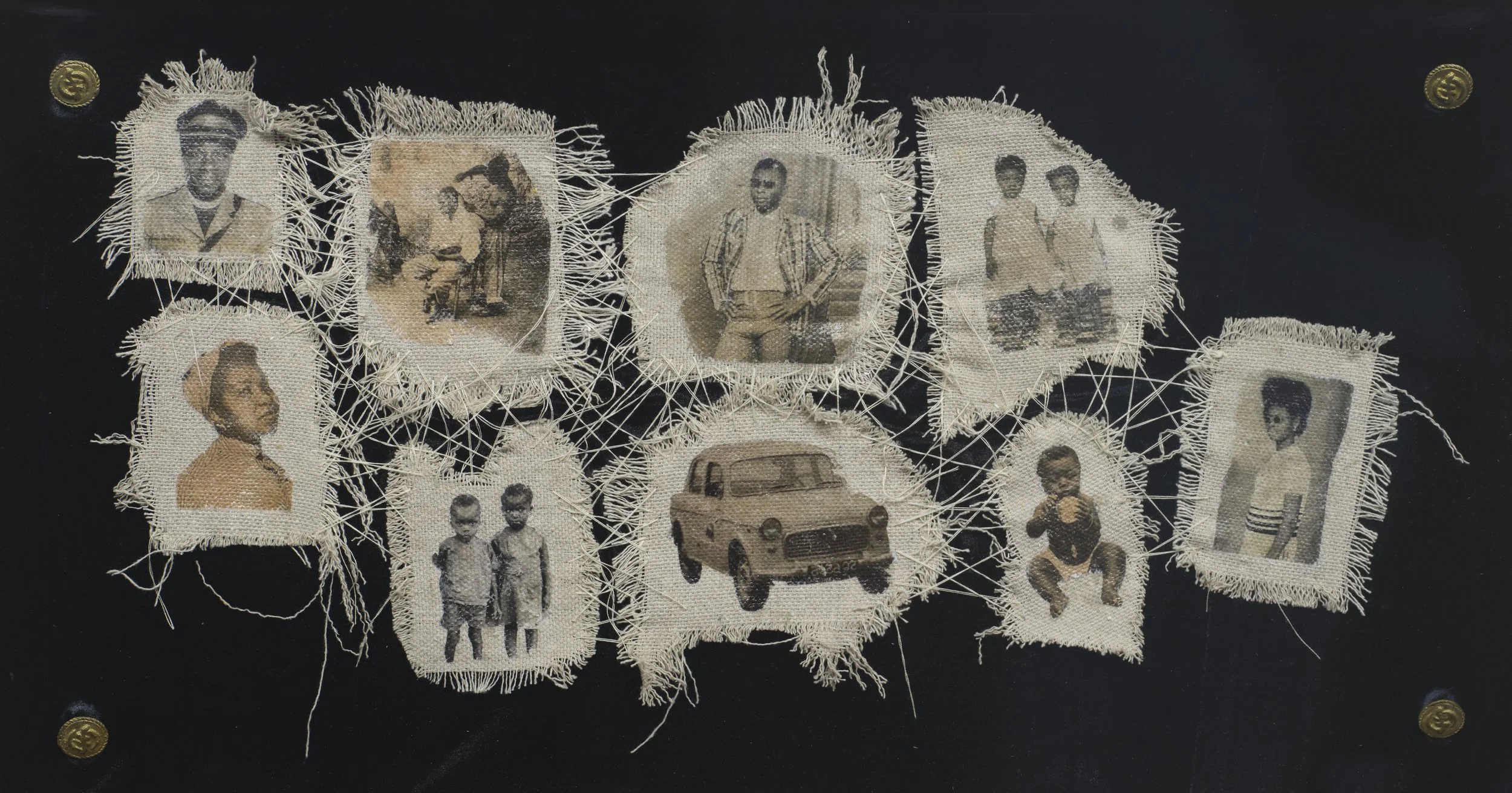
At first glance, Denyse Gawu-Mensah’s art feels like a map of memory: fragments of time, place and feeling layered into something that is at once deeply personal and universally resonant. Her practice is rooted in collecting and re-purposing, drawing from her travels across Ghana and beyond. She is an avid collector and an advocate for sentimental value, mentally and physically gathering experiences and memorabilia for the purpose of creative reuse and expression.
A graduate of the Kwame Nkrumah University of Science and Technology, Denyse’s path has been shaped by her dual passions for design and storytelling. After teaching creative arts to primary school pupils in Takoradi, she became part of Asafo Black, a collective known for its self-funded, guerrilla-style exhibitions and its appearance at the 2020 Stellenbosch Triennale in South Africa.
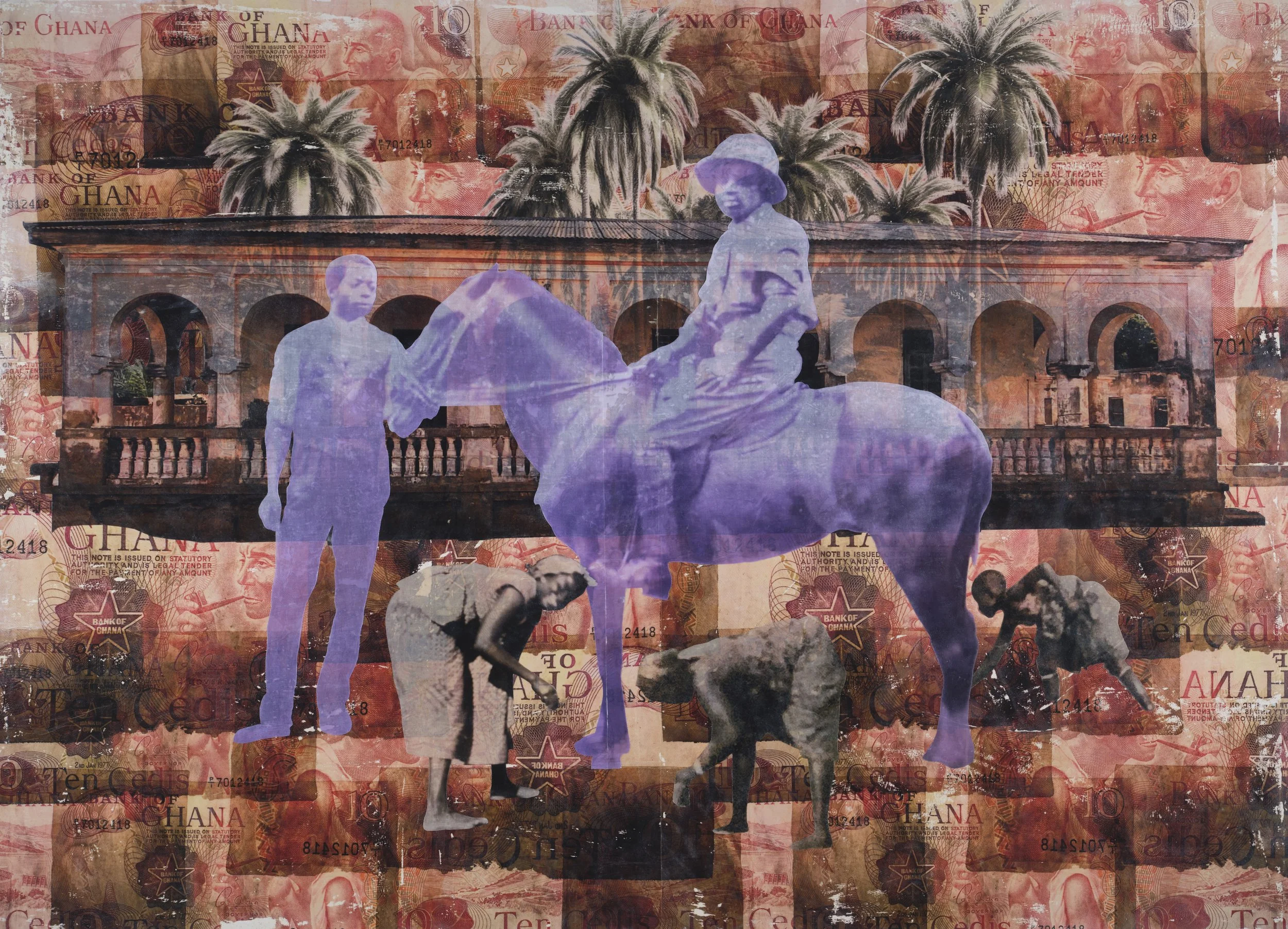
Her current work is an act of cultural preservation: a “creative way of archiving these almost forgotten lifestyles from a time of post-independence in the Ghanaian community.” Gallery 1957 describes her as “an artist who weaves memory and material into something alive; she has a remarkable ability to translate nostalgia into form, to give shape to what might otherwise fade from view.”
In her installations and mixed-media works, Denyse blurs the line between found object and fine art. She channels the textures of everyday Ghana – fabric, metal, print, even discarded objects – into narratives about identity, belonging and continuity. For her, art has become a lifestyle, exploring, collecting and making. Each piece carries a trace of where she’s been and what she’s learned.
Denyse Gawu-Mensah
Her voice is emblematic of a new generation of Ghanaian artists: unbound by medium, engaged with history and determined to use art as a living archive. Where Gawu-Mensah’s work gathers the past into tactile form, Otis Kwame Kye Quaicoe’s portraits radiate with the urgency of the present. Otis’s paintings are alive with colour and quiet power. His figures, often gazing directly at the viewer, become icons of self-assurance and reflection. “Colour,” says Gallery 1957, “is his language of transformation – social, political and personal. In his work, it is never decorative. It is a reclamation of cultural dignity.” Quaicoe’s palette burns with deep violets, ochres and greens, tones that lend each portrait an aura of both strength and stillness.
A graduate of the Ghanatta College of Art and Design, Quaicoe first exhibited with Gallery 1957 before moving to the United States, where his solo shows Black Like Me (2020) and ONE BUT TWO (Haadzii) (2021) brought him international acclaim. His recent collaboration with Zara, featuring a collection of clothing inspired by his portraits, extends his exploration of identity into wearable form, bridging art, fashion and self-expression.
“Each figure,” Gallery 1957 explains, “becomes a symbol of empowerment and redemption, sophistication and humility, curiosity and quietude. They embrace the idea of origin and personal narrative as it relates to gender and race dynamics.”
Otis was born in Accra in 1988 and is now based in Portland, Oregon. His subjects stand poised between Ghana and the wider world, between personal heritage and collective identity. They are not just portraits; they are mirrors that reflect the complexities of diaspora life and the fluidity of modern blackness. His canvases, luminous and commanding, remind viewers that representation itself is an act of power.
The continuum of Ghanaian Art
Exhibited alongside Serge Attukwei Clottey for Accra Cultural Week, whose bold yellow tapestries made from recycled plastic have become global symbols of transformation, both Gawu-Mensah and Quaicoe carry forward a distinctly Ghanaian sensibility: one that honours tradition while re-imagining it for the future.
Gallery 1957 summarises it simply: “What connects these artists is not medium but intention. They are expanding what Ghanaian art can say, and who it can speak to.”
It is a portrait of Ghanaian creativity itself: dynamic, diverse and constantly in motion.
Visit gallery1957.com for info and exhibitions in Accra, London and beyond.